
Planning a luxury home renovation in Maryland requires clear priorities, a realistic budget with contingency reserves, and a contractor who understands both high-end finishes and local permitting. Breaking the project into defined phases, communicating expectations early, and staying involved throughout are the most reliable ways to keep the process manageable from start to finish.
A major renovation can feel exciting at the start and exhausting by week three. For Maryland homeowners investing in a luxury remodel, the stakes are high enough that poor planning early on can cost far more than money. The good news is that the process becomes much less overwhelming when you treat it as a series of decisions rather than one giant project.
Key Takeaways
- Define your renovation goals before you speak to a single contractor, so you’re comparing apples to apples when reviewing proposals.
- Budget for 15–20% in contingency funds above your planned spend, particularly in older Maryland homes where surprises behind walls are common.
- Maryland’s mix of historic properties, humid summers, and clay-heavy soil creates specific challenges that a locally experienced contractor will already know how to handle.
- Permits and HOA approvals add time to the timeline; factoring them in from the start prevents delays that feel avoidable in hindsight.
- Choosing a design-build firm rather than hiring a designer and contractor separately can significantly reduce coordination friction on complex luxury projects.
- Staying involved at key milestones, without micromanaging day-to-day work, tends to produce the best results for homeowners.
Things You Must Know
1. Maryland’s Housing Stock Creates Unique Renovation Challenges
Maryland has a wide range of housing eras, from pre-Civil War farmhouses in Frederick County to mid-century colonials in Montgomery County to newer construction near Annapolis. Older homes frequently hide outdated electrical systems, galvanized plumbing, or materials that require special handling during renovation. A contractor who works locally will already understand what to look for during pre-construction assessments, which can save you from expensive surprises mid-project.
2. Luxury Renovation Is Not Just About Finishes
Many homeowners focus heavily on materials and aesthetics while underestimating the importance of structural, mechanical, and systems work. A high-end kitchen remodel, for example, often requires updated electrical panels, ventilation upgrades, and plumbing modifications before a single cabinet gets installed. Skipping or rushing these underlying systems is one of the most common mistakes homeowners make during design-build projects, and it tends to show up years later as expensive callbacks. You can read more about common mistakes homeowners make during the design-build process before finalizing your renovation plan.
3. Your Contractor Selection Has More Impact Than Your Design Choices
The contractor you hire shapes every other outcome: the quality of subcontractors, how issues get resolved, whether your timeline holds, and how the finished product compares to what you envisioned. For luxury renovations specifically, verifying a contractor’s portfolio of comparable projects, checking references thoroughly, and reviewing how they handle scope changes matters more than finding the lowest bid.
—
Where Should You Start When Planning a High-End Renovation?
The single most useful thing you can do before reaching out to contractors is to separate your “must-haves” from your “want-to-haves.” Most renovation budgets have a ceiling, and knowing which elements are non-negotiable protects you from compromising on things that actually matter to you.
Start with a written list of goals organized by room or area. Note what is functional versus what is aesthetic, and flag any issues that are safety or structural concerns. This list becomes the foundation of every contractor conversation you have.

How Do You Build a Realistic Budget for a Luxury Renovation in Maryland?
Industry data consistently shows that renovation costs in the mid-Atlantic region run higher than national averages due to labor market conditions, permit requirements, and material logistics. Maryland homeowners planning luxury-tier renovations should expect cost-per-square-foot figures that reflect this regional premium.
A realistic budget for a luxury renovation needs three layers: your planned spend on finishes and labor, your contingency reserve (typically 15–20% of total project cost), and a separate allocation for design fees and permitting if those are not bundled with your contractor. Trying to absorb contingency costs from the main budget is one of the most reliable ways to feel financially overwhelmed halfway through a project.
Whole-home luxury renovations in Maryland commonly range from $150 to $500 or more per square foot depending on the scope, materials, and age of the home. Standalone kitchen or primary bath remodels in the luxury tier can represent a significant portion of that range on their own.
For a detailed breakdown of what drives custom renovation and build costs, the custom home building cost guide from Abode Construction provides useful context on how scope, materials, and site conditions factor into overall pricing.
Budget Framework by Project Type
| Project Type | Typical Scope | Key Cost Drivers | Contingency Recommendation |
| Luxury Kitchen Remodel | Cabinetry, appliances, layout changes, finishes | Custom cabinetry, electrical/plumbing updates, countertop material | 15–20% |
| Primary Suite Addition | New square footage, bath, closet, finishes | Structural changes, HVAC extension, high-end fixtures | 18–22% |
| Whole-Home Renovation | Multiple rooms, systems updates, exterior | Scope creep, older home surprises, phased scheduling | 20%+ |
| Historic Home Restoration | Preservation work, material matching, code compliance | Specialty labor, material sourcing, permit complexity | 20–25% |
What Does the Step-by-Step Planning Process Actually Look Like?
Most luxury renovations that go smoothly share a common trait: they followed a deliberate sequence rather than making decisions reactively. Here is a practical order of operations that works well for Maryland homeowners.
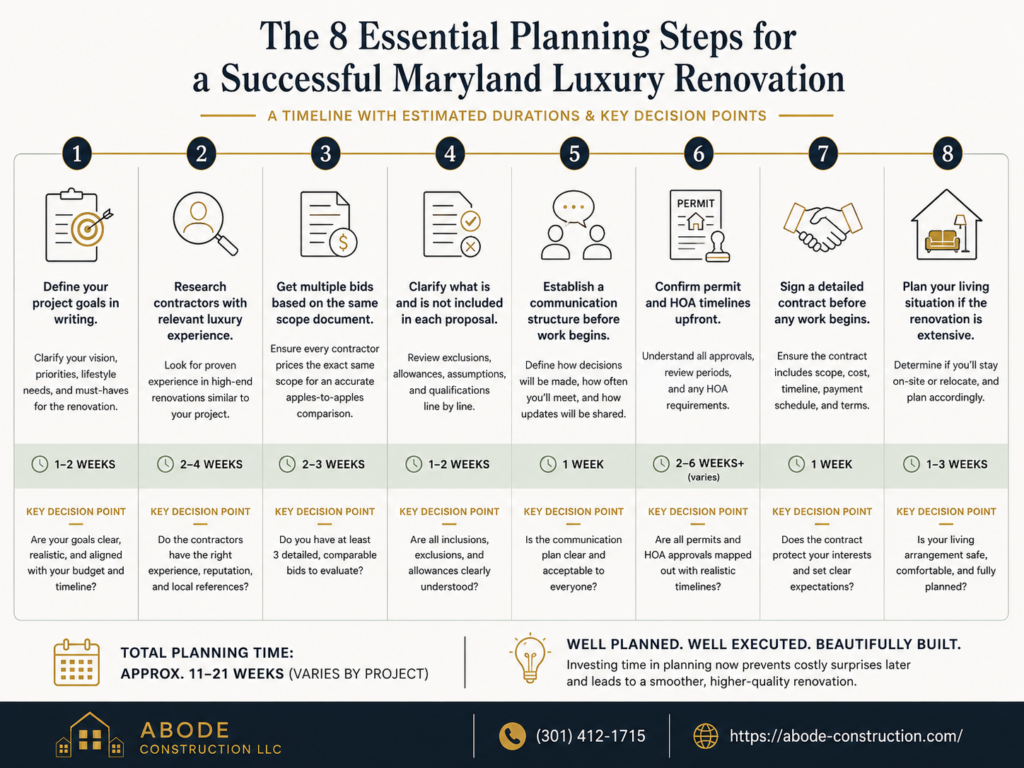
- Define your project goals in writing. Document what you want to achieve in each space, separating functional improvements from aesthetic preferences.
- Research contractors with relevant luxury experience. Look for verified portfolios, local project history, and references from comparable renovation types. The guide to choosing the right custom home builder covers what to look for during this selection process.
- Get multiple bids based on the same scope document. Provide every contractor with identical written scope so you can compare proposals meaningfully.
- Clarify what is and is not included in each proposal. Verify that permits, design fees, material procurement, and subcontractor costs are clearly addressed.
- Establish a communication structure before work begins. Agree on how often you will receive updates, who your point of contact is, and how scope changes are documented.
- Confirm permit and HOA timelines upfront. In Maryland, permit review windows vary by county. Build those timelines into your project schedule before setting a start date.
- Sign a detailed contract before any work begins. Payment schedules tied to project milestones protect both parties far better than lump-sum arrangements.
- Plan your living situation if the renovation is extensive. Whole-home or multi-room renovations in occupied homes take longer and create more friction. Decide early whether temporary relocation makes sense for your family.
Design-Build vs. Separate Designer and Contractor: Which Makes More Sense?
For luxury renovations above a certain complexity threshold, the design-build model tends to reduce friction significantly. When a single firm manages both design and construction, scope gaps (the spaces where designers and contractors disagree on what was intended) become the firm’s problem to resolve internally rather than the homeowner’s.
Research on construction project outcomes has found that design-build projects tend to deliver faster timelines and fewer cost overruns compared to traditional design-bid-build arrangements, particularly for complex residential scopes.
The design-build process for custom homes outlined by Abode Construction explains how this integrated approach works in practice and what homeowners can expect at each stage.
| Approach | Best For | Potential Drawback |
| Design-Build Firm | Complex scopes, whole-home renovations, tight timelines | Less ability to shop individual vendors separately |
| Separate Designer + Contractor | Phased projects, homeowners with strong design preferences | Higher coordination burden, more potential for scope gaps |
| Architect-Led Project | Structural changes, additions, historic work | Longer design phase, higher upfront costs |
Common Mistakes That Make Luxury Renovations Feel Overwhelming
Most renovation stress does not come from the work itself. It comes from decisions made (or not made) before the project started. These are the patterns that tend to create the most friction.
- Starting with materials before finalizing scope. Selecting tile and fixtures before the structural plan is confirmed leads to costly changes or mismatched selections.
- Underestimating permit timelines. In Maryland, certain counties require extended review periods for structural or historic work. A one-week permit assumption that becomes a six-week wait throws off every downstream schedule.
- Skipping a pre-construction assessment. For homes built before 1980, a pre-construction inspection can identify hazardous materials, outdated systems, or structural concerns before they surface mid-project.
- Changing scope after construction begins. Mid-project changes are the single greatest driver of cost overruns and timeline extensions on luxury renovations.
- Choosing the lowest bid without verifying scope equivalence. Bids that look significantly lower often exclude items that other contractors included. Comparing line items, not totals, is the safer approach.
- Not clarifying who handles material procurement. For luxury projects, sourcing lead times on custom cabinetry, imported stone, or specialty fixtures can run 8–14 weeks. If procurement responsibility is unclear, delays are almost certain.
Understanding the full scope of luxury home renovations before committing to a plan helps homeowners avoid these patterns from the start.
Frequently Asked Questions
How do I choose the right contractor in Maryland?
Look for contractors with a verifiable portfolio of luxury-tier projects in Maryland specifically, not just general renovation experience. Ask for references from projects with comparable budgets and scope, and verify that their licensing and insurance are current with Maryland’s requirements. Beyond credentials, pay attention to how clearly and promptly they communicate during the proposal process; that pattern tends to continue throughout construction.
How much should I budget for unexpected costs?
A contingency reserve of 15–20% of your total planned budget is a widely recommended starting point for luxury renovations. For older Maryland homes, particularly those built before 1970, erring toward 20% or higher is more realistic given the likelihood of discovering outdated systems, moisture issues, or structural surprises once walls are opened. Treat this reserve as an expected part of the budget, not a worst-case scenario fund.
Will I need special permits for a historic home in Maryland?
Potentially, yes. Maryland has a number of designated historic districts, particularly in areas like Annapolis, Frederick, and parts of Montgomery and Prince George’s counties. Renovations within these areas may require review by a local historic preservation commission in addition to standard building permits. The review process can add weeks or months to your pre-construction timeline, so it is worth confirming the status of your property early. Your contractor or architect should be able to identify applicable requirements before you finalize any plans.
Should I live in the house during a major renovation?
For extensive renovations covering multiple rooms or major systems, temporary relocation often leads to faster project completion and less daily disruption for your family. Living on-site during heavy construction can also unintentionally slow work, as crews may modify their schedules around occupied areas. For smaller, contained renovations such as a single-room remodel, staying in the home is usually manageable as long as you establish clear work-hour boundaries and dust containment expectations with your contractor upfront.
How can I avoid costly delays during my renovation?
The most effective delay prevention happens before construction begins. Finalizing all design decisions, confirming material lead times, and securing permits before the start date eliminates the most common sources of stoppage. During construction, respond promptly to requests for decisions or approvals from your project manager; delayed homeowner responses are one of the most frequently cited causes of schedule slippage. Having a single point of contact who can make decisions quickly on your behalf is useful if your schedule is demanding.
Ready to Start Your Maryland Renovation the Right Way?
A luxury renovation handled well should feel like a managed process, not a prolonged crisis. The difference almost always comes down to preparation: knowing what you want, choosing the right team, and building a realistic plan before the first hammer swings.
Abode Construction LLC works with Maryland homeowners on high-end renovation and custom build projects, bringing a process-oriented approach that keeps projects on track from the initial planning phase through final walkthrough. If you are ready to talk through your project, call the team at (301) 412-1715 to schedule a consultation and start planning with confidence.

Scott Saling is the owner of Abode Construction LLC, a residential contracting and remodeling company based in Gaithersburg, MD. A second-generation contractor and third-generation Marine Corps veteran, he brings military-level planning, discipline, and attention to detail to every project.
With two combat deployments to Iraq, Scott values clear communication above all, believing that keeping homeowners informed at every stage is key to a successful project. His commitment to transparency, craftsmanship, and customer satisfaction drives every renovation his team delivers.