
A client portal centralizes all project communication, documents, daily logs, and progress photos in one place, giving homeowners real-time visibility into their luxury renovation without relying on scattered phone calls or emails. For high-end projects in the Maryland and Washington, DC area, this level of structured transparency reduces misunderstandings, protects the client’s investment, and keeps complex multi-phase builds on track.
Luxury renovations involve a lot of moving parts: architects, engineers, interior designers, permit coordinators, and trade crews all working in sequence. Without a structured system tying everything together, even well-managed projects can create unnecessary anxiety for the homeowner. A dedicated client portal changes that by giving you a single, organized window into your project at every stage.
Key Takeaways
- A client portal consolidates communication, documents, and project updates in one accessible place, eliminating the need to chase down information across multiple channels.
- Real-time progress photos and daily logs let homeowners stay connected to their renovation without needing to be on-site every day.
- Centralized documentation protects both the homeowner and the builder by creating a clear, timestamped record of decisions, approvals, and changes.
- For luxury projects in Maryland and the DC Metro area, where renovations often involve permitting, HOA coordination, and multi-trade scheduling, structured communication is especially important.
- The right firm handles communication as a built-in part of the process, not an afterthought, so clients always know where their project stands.
Things You Must Know
1. Communication breakdowns are one of the most common sources of renovation disputes
Scope changes, unclear approvals, and conflicting instructions between trades are frequently cited as reasons renovations run over budget or over schedule. A portal that documents every decision and conversation creates accountability on both sides. Before hiring any contractor for a luxury project, ask specifically how they handle change orders, design approvals, and progress reporting in writing.
2. Not all portals offer the same level of transparency
Some contractors use basic shared folders or group texts and call it a “portal.” A genuinely useful client portal provides daily logs, photo documentation organized by project phase, a message thread tied to specific decisions, and easy access to contracts, permits, and selections. Ask to see a demo or sample view of what you’ll actually receive before the project begins.
3. Integrated design-build firms are better positioned to centralize communication
When architecture, engineering, interior design, and construction are handled by separate companies, information gets siloed. A fully integrated design-build firm can feed all of those disciplines into one unified communication system, which means fewer handoff errors and a more coherent project record for the homeowner.
Why Does Communication Go Wrong on Luxury Renovation Projects?
High-end renovations are more complex than standard remodels. They typically involve longer timelines, more specialized trades, custom material lead times, and layered approval processes including permits, HOA requirements, and in some Maryland neighborhoods, historic preservation guidelines. Each layer adds a potential communication gap.
The most common failure points are easy to predict: a design decision gets made verbally but never documented, a material substitution is approved by one person but the crew hears something different, or a schedule change isn’t communicated until work has already begun. None of these are malicious. They happen because information is moving through too many informal channels at once.
Studies in the construction industry consistently identify poor communication as a leading cause of project delays, cost overruns, and client dissatisfaction, with some research suggesting that miscommunication contributes to a significant percentage of rework costs on residential projects.
A client portal doesn’t eliminate complexity. It gives complexity a structure, so nothing critical falls through the cracks.
What Does a Client Portal Actually Do on a Renovation Project?
The term “client portal” covers a range of tools, but the most useful ones for luxury renovation projects do several things consistently well.
| Portal Feature | What It Does for You | Why It Matters on Luxury Projects |
| Daily Logs | Crew notes what was completed each day | You know exactly where the project stands without needing to call anyone |
| Progress Photos | Time-stamped photos organized by phase | Provides visual confirmation of work and a record for future reference |
| Document Storage | Contracts, permits, selections, and specs in one place | Eliminates lost paperwork and version confusion during long projects |
| Change Order Tracking | Written record of scope changes and approvals | Protects the homeowner and the firm from billing disputes |
| Weekly Updates | Scheduled summary of progress, upcoming milestones, and open items | Keeps the client informed on a predictable cadence rather than reactively |
When all of this lives in one place, the homeowner isn’t dependent on a single point of contact who may be hard to reach. The information is always accessible, which is especially valuable for executives and business owners who can’t monitor a job site during work hours.
How Does a Client Portal Protect Your Investment?
A luxury renovation is a significant financial commitment. For homeowners in Potomac, Bethesda, Chevy Chase, or similar high-value markets, a whole-home renovation or large addition represents hundreds of thousands of dollars and months of work. The portal is partly a communication tool, but it’s also a financial protection tool.
Undocumented verbal change orders are among the most common triggers for construction litigation between homeowners and contractors, according to construction law practitioners. Having a portal where every change is logged, approved, and timestamped significantly reduces this risk.
When a design decision is documented and signed off in the portal, both parties share the same record. There’s no “I thought you said” confusion months into a project when costs and timelines are at stake. That clarity matters most on large projects, where even a single undocumented scope change can ripple into significant budget variance.
If you’re planning a major renovation and want to understand the full process before it begins, planning a luxury home renovation in Maryland involves more preparation than most homeowners initially expect, and a well-structured communication system is part of that foundation.
What Should You Expect Week by Week?
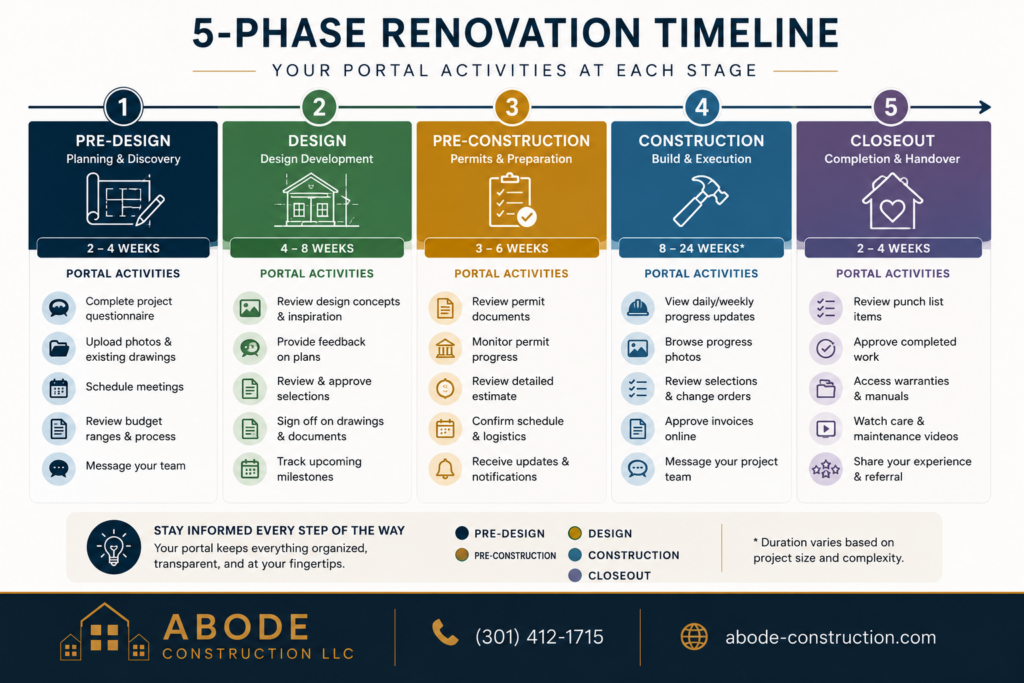
Structured communication isn’t just about having access to a portal. It’s about knowing what to expect and when. Here’s how a well-run luxury renovation project should communicate with you throughout the process.
- Pre-Construction Phase: All signed contracts, design drawings, permit applications, and material selections are uploaded to the portal before work begins. You have a baseline reference point before the first crew arrives.
- Demolition and Rough Work: Daily logs document what was removed, discovered, or modified. Progress photos capture behind-the-wall conditions that inform decisions about insulation, framing, or mechanical systems before they’re closed up.
- Structural and Systems Work: Photos of framing, electrical, plumbing, and HVAC rough-ins are logged before inspections. Permit inspection results are uploaded when available so you have a continuous compliance record.
- Finish Work: Weekly summaries highlight which selections have been ordered, what’s been installed, and what’s pending. This is where most client decisions converge, so clear documentation prevents installation errors.
- Punch List and Closeout: Outstanding items are tracked in the portal and checked off as each one is completed. Final documents, warranties, and as-built drawings are stored for future reference.
How Does an Integrated Design-Build Model Strengthen Portal Communication?
The client portal is only as good as the information being fed into it. When a renovation involves separate architecture, design, and construction firms, information often gets siloed between companies and has to be manually reconciled before it reaches the client.
A fully integrated design-build firm eliminates that gap because all disciplines report into the same system. The architect’s design decisions, the engineer’s structural notes, the interior designer’s selection confirmations, and the construction crew’s daily logs all flow into one platform. Nothing requires translation between companies before it reaches you.
Design-build project delivery has been associated with faster schedules and fewer change orders compared to traditional design-bid-build approaches, in part because a unified team structure reduces the communication overhead between separate firms.
For homeowners evaluating contractors, understanding why design-build is a better fit for luxury home renovations helps clarify why the structure of the firm you hire directly affects the quality of communication you receive.
Common Mistakes Homeowners Make Around Renovation Communication
- Accepting verbal updates as sufficient: If it isn’t documented in writing, it doesn’t exist in any useful legal or practical sense. Always confirm decisions, changes, and timelines in a written format that’s tied to your project record.
- Assuming no news means good news: On a well-run project, you should be receiving regular updates even when there’s nothing urgent to report. Silence is not a sign of smooth progress; it’s often a sign of poor process.
- Not reviewing daily logs or photos: The portal is only useful if you’re using it. Reviewing logs a few times a week allows you to spot discrepancies early before they compound into larger issues.
- Treating the portal as a messaging app: A client portal should store formal decisions and approvals, not replace structured project management. Use it as the record of your project, not just a chat thread.
- Choosing a contractor without asking about their communication process: Before signing a contract, ask specifically how progress is reported, how changes are documented, and what platform the team uses. A vague answer is a warning sign.
| Communication Approach | Traditional Contractor | Integrated Design-Build with Portal |
| Project Updates | Ad hoc calls or texts | Daily logs and weekly summaries in portal |
| Change Orders | Often verbal, documented later if at all | Written, approved, and logged before work proceeds |
| Document Access | Request by email, may take days | Always available in the portal |
| Progress Visibility | Requires site visits or calls | Photos and logs accessible remotely at any time |
| Cross-Discipline Coordination | Client manages communication between firms | One firm coordinates everything; client sees one unified view |
Understanding what to expect from a full-service luxury renovation contractor can help you evaluate which approach will actually serve your project and your peace of mind.
Frequently Asked Questions
What are the benefits of using a client portal during a renovation?
A client portal gives you a single place to access daily logs, progress photos, project documents, and communication history. It removes the need to chase down updates across texts, emails, and phone calls. For a luxury renovation where dozens of decisions are made over many months, that centralization protects both the quality of the project and the homeowner’s peace of mind. It also creates a written record that can be referenced if any question arises later about what was approved or when.
What are some steps a contractor should take to improve client communication?
The most effective steps are establishing a consistent update cadence (daily logs and weekly summaries), centralizing all project documents in a portal, requiring written approval for any scope change, and assigning a dedicated point of contact for the homeowner. Communication should be proactive, meaning the client receives updates on a schedule, not only when there’s a problem to report. Firms that treat communication as a structured part of their process rather than a reactive one tend to have significantly fewer disputes and higher client satisfaction.
How should a design-build firm communicate with clients during the design process?
During design, communication should focus on clarifying the homeowner’s vision, confirming selections, and documenting approvals at each milestone before moving forward. This typically includes design presentation meetings, written confirmation of finalized selections, and a clear record of any revisions. When the design team and construction team operate under the same roof, those design decisions can be logged in the same portal the construction crew uses, so there’s no translation layer between what was designed and what gets built.
Why is communication especially important in luxury home renovations?
Luxury renovations involve higher financial stakes, more complex coordination across trades and disciplines, and a higher standard of craftsmanship where small deviations from the plan matter. A miscommunication that might be a minor inconvenience on a small remodel can become a costly correction on a high-end project. Clear, documented communication reduces rework, protects the homeowner’s investment, and maintains the level of precision that a premium renovation demands from start to finish.
What are the three C’s of effective communication on a construction project?
In the context of renovation project management, the three C’s are typically clarity, consistency, and confirmation. Clarity means instructions and decisions are stated without ambiguity. Consistency means updates happen on a predictable schedule so the client always knows what to expect. Confirmation means every decision, approval, and change is documented before work proceeds. A well-designed client portal supports all three by building them into the process rather than relying on individuals to remember them.
A Renovation You Can Follow From Start to Finish
A luxury renovation should feel like a well-managed process, not a stressful information gap. When communication is structured and transparent, homeowners can make better decisions, stay connected to their project on their own schedule, and move through the process with confidence rather than uncertainty.
Abode Construction is a veteran-owned, fully integrated design-build firm serving Maryland and the Washington, DC Metro area, including Bethesda, Potomac, Rockville, Chevy Chase, and surrounding communities. Every project includes a dedicated client portal with daily logs, progress photos, and centralized communication so you always know exactly where your renovation stands.
If you’re planning a significant renovation and want a team that treats communication as part of the build, reach out to Abode Construction to start the conversation.

Scott Saling is the owner of Abode Construction LLC, a residential contracting and remodeling company based in Gaithersburg, MD. A second-generation contractor and third-generation Marine Corps veteran, he brings military-level planning, discipline, and attention to detail to every project.
With two combat deployments to Iraq, Scott values clear communication above all, believing that keeping homeowners informed at every stage is key to a successful project. His commitment to transparency, craftsmanship, and customer satisfaction drives every renovation his team delivers.