
A custom home builder manages the entire design and construction of a new home from the ground up, while a general contractor oversees specific construction projects and subcontractors, often working from pre-existing plans. In Maryland, the distinction matters significantly because local permitting, site conditions, and housing styles vary by county. Choosing the wrong professional for your project can add cost, delays, and frustration.
You’ve found your lot. You know roughly what you want. Now you’re trying to figure out who actually builds the thing. The terms “custom home builder” and “general contractor” get used interchangeably all the time, but in Maryland’s construction market, they describe fundamentally different relationships, scopes of work, and outcomes. Getting this distinction right before you sign anything could save you tens of thousands of dollars and months of your life.
Key Takeaways
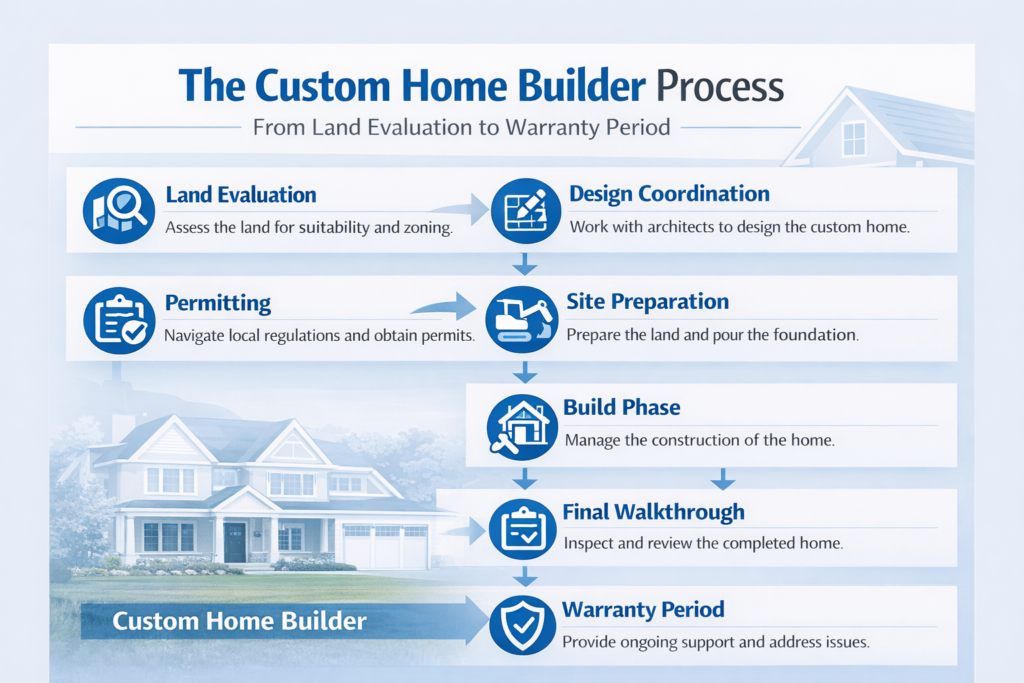
- Custom home builders manage the full project lifecycle, from design through final walkthrough, while general contractors typically execute pre-defined plans.
- In Maryland, custom builders often have deeper familiarity with county-level permitting requirements in areas like Montgomery, Prince George’s, and Frederick counties.
- General contractors are often the right choice for renovations, additions, or projects with existing architectural drawings already in hand.
- Custom home builders typically carry the architect-builder relationship in-house or through dedicated partnerships, reducing coordination gaps.
- Warranty structures, contract types, and accountability differ meaningfully between the two roles.
- The Cost to Build a Custom Home in Maryland will differ depending on which professional type you hire and how your project is scoped.
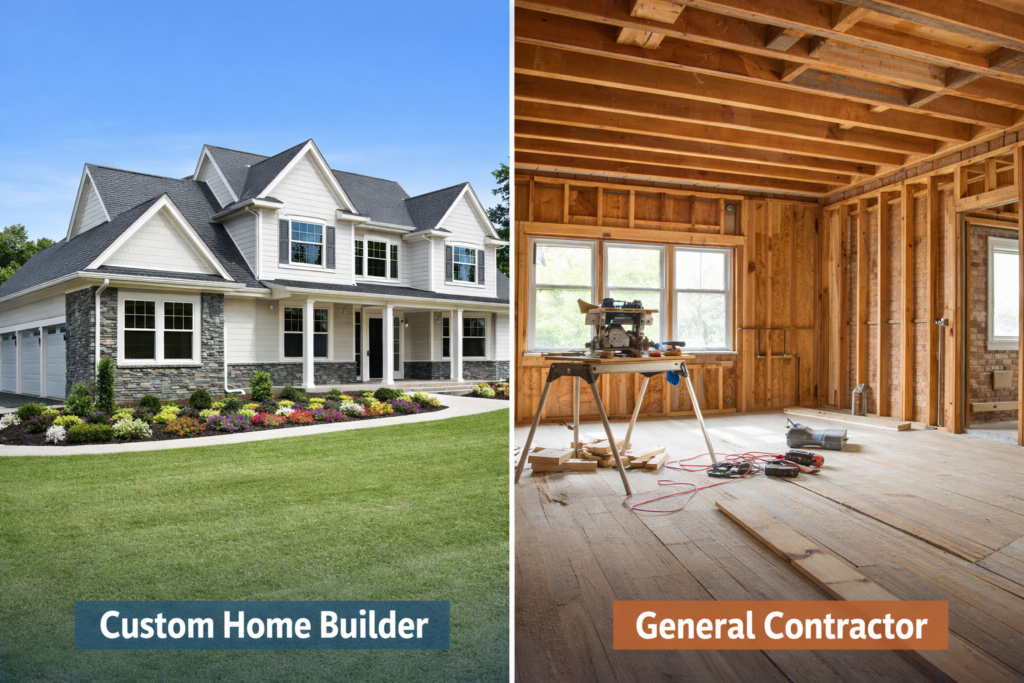
What Does a Custom Home Builder Actually Do?
A custom home builder is responsible for everything from site evaluation and architectural coordination to construction management and final inspections. They don’t just build what’s handed to them. They help shape the project from the concept stage forward, working with the homeowner to define scope, materials, layout, and budget before a single foundation is poured.
In Maryland specifically, that process includes navigating county-specific requirements that vary widely. A builder operating in Montgomery County faces different stormwater management rules, setback requirements, and inspection timelines than one working in Anne Arundel or Howard County. Familiarity with local jurisdictions is not a minor detail. It directly affects how quickly your project moves and how much revision you’ll face during permitting.
Custom builders also tend to maintain long-term relationships with subcontractors, from electricians and framers to cabinet makers and tile installers. That network matters. When a scheduling gap opens up or a material is backordered, a builder with established trade relationships can often solve problems faster than someone assembling a crew from scratch for each job.
What Does a General Contractor Do Differently?
A general contractor (GC) is hired to execute a defined scope of construction work. They manage subcontractors, coordinate materials, interpret architectural plans, and keep the job site on schedule. But in most cases, the GC enters the project after the plans already exist.
That’s the core structural difference. A GC works from instructions. A custom home builder helps create those instructions. If you already have a fully stamped set of architectural drawings and simply need someone to build from them, a qualified general contractor may be exactly what you need. If you’re starting from a concept or a lot with no plans yet, a custom builder is typically the more appropriate starting point.
| Factor | Custom Home Builder | General Contractor |
| Project entry point | Before design begins | After plans are finalized |
| Design involvement | High — coordinates with architect or leads in-house | Low — interprets existing drawings |
| Best project type | New custom builds from scratch | Renovations, additions, plan-ready builds |
| Permitting familiarity | Deep, county-specific experience | Varies by contractor and project history |
| Subcontractor network | Established, vetted, long-term relationships | Varies, sometimes assembled per project |
| Warranty coverage | Often broader, includes builder’s warranty | Typically limited to workmanship warranty |
| Design-build capability | Yes, often offered as a package | Rarely — not the primary role |
How Maryland’s Local Regulations Shape the Decision
Maryland requires home builders to be licensed through the Maryland Home Builder Registration Unit (HBRU), which is separate from a general contractor’s license. Custom home builders who construct more than one new home per year are required to register under state law, carry a performance bond, and participate in the Maryland Guaranty Fund, which protects buyers from financial losses due to builder default.
General contractors, by contrast, are licensed at the county level in Maryland and are not automatically subject to the same Guaranty Fund requirements unless they’re classified as home builders under state law. This is not a minor bureaucratic distinction. If something goes wrong during or after construction, your recourse options depend heavily on which type of professional you hired and how they were classified at the time.
Montgomery and Prince George’s counties have among the more complex residential permitting processes in the state, often requiring stormwater management plans, forest conservation approvals, and sediment control permits in addition to standard building permits. Custom home builders who work regularly in these jurisdictions have typically developed relationships with county plan reviewers that can shorten review timelines by several weeks.
How to Choose: A Step-by-Step Decision Framework
- Define your starting point. Do you have architectural plans already, or are you starting from an idea and a lot? If it’s the latter, a custom home builder should be your first call, not your last.
- Clarify your project type. New ground-up construction almost always benefits from a custom builder’s full-service approach. Additions and major renovations may be well-suited to a qualified GC with the right experience.
- Research Maryland licensing. Verify that any professional you consider holds the appropriate Maryland HBRU registration (for builders) or county-level contractor license (for GCs). Don’t skip this step.
- Ask about their local permitting history. Request specific examples of projects completed in your county. Someone who has built extensively in Frederick County may not know Frederick County’s specific requirements as well as someone with a deep local record there.
- Review contract structures. Custom builders often use cost-plus or fixed-price build contracts that include design coordination. GC contracts typically assume completed plans. Know what you’re signing.
- Confirm warranty terms in writing. Understand what’s covered, for how long, and through what mechanism. Maryland state law provides certain implied warranties on new homes, but explicit contract terms still matter.
If you want a deeper look at how to evaluate your options, the Right Custom Home Builder guide offers a practical framework for assessing builders before you commit.
What Does Each Cost in Maryland?
Custom home construction in Maryland typically ranges from $250 to $500 per square foot for the build alone, depending on finish level, location, and site conditions. Suburban counties like Howard and Montgomery tend toward the higher end of that range due to land costs, labor rates, and permitting complexity. These figures do not include land acquisition, which in the D.C. suburbs can add $150,000 to $600,000 or more to total project cost.
General contractors working from existing plans in Maryland typically charge a markup of 10 to 20 percent on subcontractor and material costs, or a flat management fee negotiated at project start. For major renovations in the $200,000 to $500,000 range, that markup can represent $20,000 to $100,000 in additional cost above hard construction expenses. Understanding how your GC structures their fee before finalizing a contract is essential.
| Cost Category | Custom Home Builder | General Contractor |
| Design coordination | Often included or bundled | Separate cost — hire architect independently |
| Fee structure | Fixed price or cost-plus contract | Markup on subs/materials or flat fee |
| Typical Maryland project range | $400K–$1.5M+ (new build) | $100K–$600K (renovation/addition) |
| Permitting costs | Managed within builder’s scope | Often passed through at cost |
Common Mistakes Maryland Homeowners Make
- Hiring a GC for a design-first project. If you don’t have plans yet and hire a GC anyway, you’ll end up paying an architect separately and coordinating between two parties who may have conflicting priorities.
- Assuming all licenses are the same. A licensed general contractor in Maryland is not automatically registered as a home builder under state law. These are different designations with different legal protections for the buyer.
- Skipping the warranty conversation. Maryland law provides implied warranties on new residential construction, but the scope and duration depend on contract language. Always review warranty terms before signing.
- Choosing on price alone. The lowest bid rarely reflects the full project cost once scope changes, allowances, and subcontractor turnover are factored in.
- Not asking about subcontractor relationships. A builder who hires different subs on every project may face scheduling and quality inconsistencies that a builder with a stable trade network avoids.
- Ignoring local permitting experience. In Maryland’s most regulated counties, a builder unfamiliar with local review processes can face delays measured in months, not weeks.
Understanding the Design-Build Process can help you see how integrated project delivery avoids many of these coordination pitfalls from the start.
Areas in Maryland Where This Decision Comes Up Most
This builder-vs-contractor question comes up frequently across Maryland’s most active residential markets. Custom home building is particularly common in areas like Potomac, Bethesda, Chevy Chase, Clarksville, Ellicott City, and Annapolis, where lot availability is limited but demand for high-specification homes remains strong.
General contractors tend to be more prevalent in renovation-heavy urban markets like Silver Spring, Rockville, College Park, and older neighborhoods of Baltimore City, where the existing housing stock is being updated rather than replaced. If you’re exploring a custom home builder Maryland option in any of these areas, local experience is one of the most valuable credentials to look for.
Frequently Asked Questions
Which is more expensive: a custom home builder or a general contractor?
It depends entirely on project scope. A custom home build managed by a custom builder typically costs more in total because it includes design, coordination, and construction of an entirely new structure. A general contractor managing a renovation from existing plans may cost less in fee structure, but you’ll pay separately for architectural drawings. The right comparison is total project cost, not contractor fees in isolation.
Which is better for fully custom design?
A custom home builder is the clear choice when you want meaningful input at the design stage. They either work with a design partner or have in-house design capability, and they can translate your preferences into buildable plans before construction begins. A general contractor builds from specifications that already exist, so the design phase typically isn’t within their scope. Review the questions to ask custom home builder Maryland before your first meeting to make the most of that conversation.
Do custom home builders and general contractors need different licenses in Maryland?
Yes. Maryland requires custom home builders who construct more than one new home per year to register with the Home Builder Registration Unit (HBRU) and participate in the Maryland Guaranty Fund. General contractors are licensed at the county level and are not subject to these same requirements unless they meet the state’s home builder definition. Always verify the correct license type before signing a contract.
How are projects managed differently between the two?
A custom home builder typically acts as the single point of accountability across design, permitting, subcontractor coordination, and construction. A general contractor manages the build phase specifically, often relying on the homeowner or a separate architect to handle pre-construction coordination. For complex new builds, the custom builder’s integrated model generally reduces communication gaps and delays.
Which offers better warranty protection?
Custom home builders in Maryland who are registered under the HBRU typically provide a builder’s limited warranty backed by the Maryland Guaranty Fund, which offers an additional layer of protection if the builder defaults. General contractors typically offer a workmanship warranty tied to the specific scope of work, which may not cover structural defects or systems-level issues in the same way. Always get warranty terms in writing, regardless of which professional you hire.
Conclusion: The Right Professional for Your Maryland Project
The distinction between a custom home builder and a general contractor isn’t just a matter of title. It reflects a fundamentally different relationship with your project, your timeline, and your long-term protection as a homeowner. In Maryland, where permitting complexity, county-level variation, and housing market demands all shape what successful construction looks like, choosing the right professional at the start of the process matters as much as any material or design decision you’ll make.
If you’re starting from scratch on a lot or a vision, a custom home builder gives you the coordination, expertise, and accountability that a fragmented approach simply can’t replicate. If you have completed plans and a well-defined renovation scope, a licensed general contractor with the right local experience may be exactly what the project needs.
At Abode Construction, we work with Maryland homeowners across the full custom build process, from initial site evaluation through final walkthrough. If you’re still weighing your options or ready to talk specifics about your project, call us at (301) 412-1715. We’re happy to have a straightforward conversation about what your project actually needs and who’s best positioned to deliver it.

Scott Saling is the owner of Abode Construction LLC, a residential contracting and remodeling company based in Gaithersburg, MD. A second-generation contractor and third-generation Marine Corps veteran, he brings military-level planning, discipline, and attention to detail to every project.
With two combat deployments to Iraq, Scott values clear communication above all, believing that keeping homeowners informed at every stage is key to a successful project. His commitment to transparency, craftsmanship, and customer satisfaction drives every renovation his team delivers.